


Karaoke is a form of entertainment in which a person sings along to the instrumental version of a song while reading the lyrics on a screen. The word is Japanese: kara means “empty” and oke is short for ōkesutora, “orchestra” — literally an “empty orchestra”. It was born in Japan in the early 1970s.
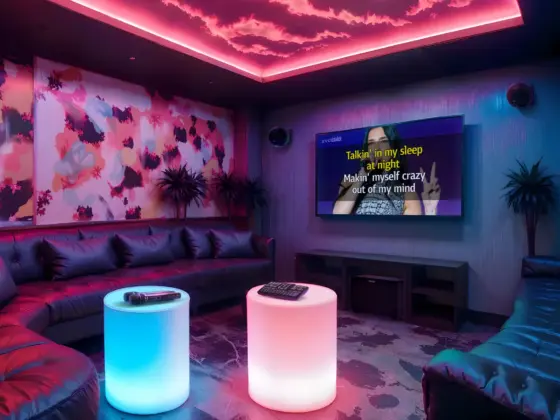
Depending on the context, karaoke can mean a type of entertainment venue, singing along to a backing track, or the actual device that plays the instrumental. But whatever the context, we always picture a microphone, the bright glow of a screen with lyrics, and a festive atmosphere.
What does the word karaoke mean?
Karaoke is a compound word: kara (空) means “empty”, and oke is short for ōkesutora, the Japanese word for “orchestra”. Literally, an “empty orchestra”: the music is there, but the voice is missing, and the singer fills it in.
Who invented karaoke?
There is no definitive answer as to how and where karaoke appeared. If we are talking about singing to music without words, records with backing tracks intended for home performance were already being released back in the 1930s. If we mean the karaoke player, its prototype appeared in Japan in the early 70s thanks to musician Daisuke Inoue, who used recorded backing tracks during his performances so he could take a break without letting the audience’s energy drop.
His machine, the “8 Juke”, combined an 8-track cartridge player, an amplifier and a microphone, and from 1971 it was rented out to bars in Kobe. Inoue never patented his invention.
Singing along to backing tracks was so beloved by the Japanese that an entire industry producing karaoke machines for bars and clubs soon emerged. In the early 80s, karaoke crossed the ocean and landed in the USA. Initially received coolly, karaoke got a new wave of popularity with the creation of the first home karaoke players. You can learn more about the history of karaoke in the article “The Evolution of Karaoke”.
Read also: What Is a Karaoke Bar
How does karaoke work?
The performer’s voice went through the microphone into the device’s mixer, where it was blended, layered over the backing track, and output together with the music to an external audio system. The lyrics were read from the TV screen. In the background, the original music video or specially shot footage — a video clip with neutral content — was playing.
Types of karaoke
In bars and clubs, people sing in front of the whole room. Japan popularised “karaoke boxes” — private rooms for a group of friends — and in South Korea the same format is called noraebang (“song room”).
Home karaoke changed everything. Those who were shy about going to karaoke clubs or preferred to sing only among family got a unique opportunity to throw parties and musical celebrations in their own living room. This greatly contributed to the further popularization of karaoke as entertainment.
Completely new karaoke formats began to appear. For example, karaoke taxis or numerous karaoke shows on television. Karaoke clubs did not stand still either, offering guests previously unimaginable sound quality and additional services, and taking a worthy place on the entertainment map of the night city.
What do you need for karaoke at home?
The basics are a karaoke system with a song catalogue, one or two wireless microphones, a screen for the lyrics (a TV will do) and good sound: speakers or a soundbar. Modern systems also let you record your performance in near-studio quality, share it on social media and use several microphones at once.
So what is karaoke? A digital device, entertainment, or a club format? All of the above and at the same time none of them. Karaoke is a lifestyle, a mood, emotions that are born deep in the soul and cannot be held back. Karaoke is the best thing that can happen to you on a Saturday night.
Read also: What Is a Karaoke System? Complete Guide to Equipment, Types, and Features